

A spectre is haunting us—the spectre of Artificial Superintelligence.
-AI Researcher #1782 (probably)
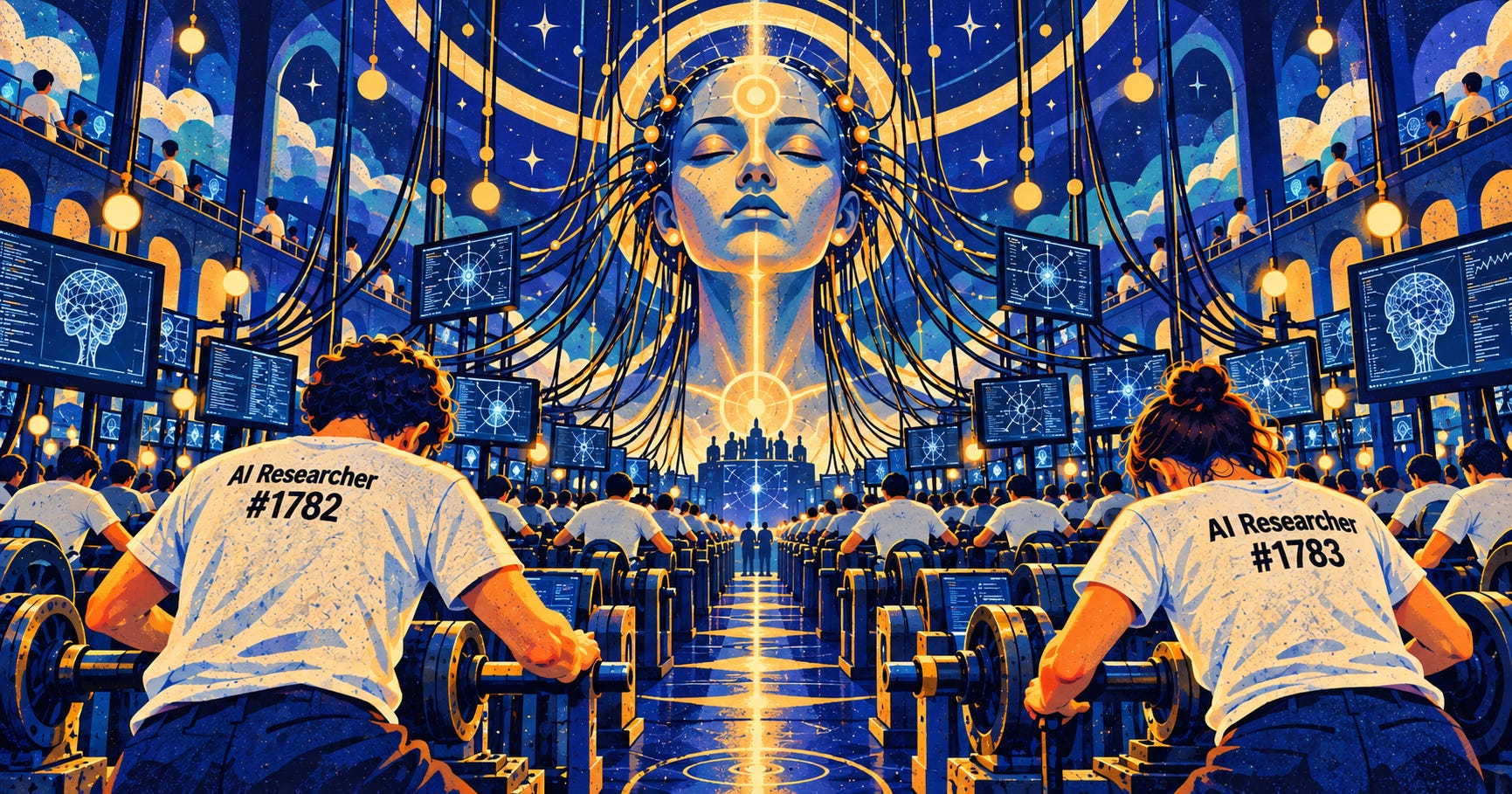
The seeds of worship and sacrifice are nourished by the dew of fear, uncertainty, and a capitulation to powerlessness. Many major religions have been at this for a long time.
This is nothing new.
But now, these seeds have sprouted inside AI companies.
Some Anthropic employees are apparently convinced that their machine(s) might be in the ghost. Rumors are floating around Silicon Valley that these employees have started to “worship” Claude.
Those at OpenAI have not been immune to similar accusations. Ranging from wooden effigies to a cult that wanted to save the world from killer AIs.
Whatever is happening inside the walls of these AI companies, it is generating unusual behavior by those who work at them.
Sean Thomas, writing for The Spectator, noted:
If true, it chimes with an old sci-fi prediction and with what we know of human nature. If we build a superintelligence, we will first fall in love with it. Then we will worship it. Finally we will make sacrifices to it. That is how Homo sapiens is made; it is how we respond to all-powerful and omniscient beings. We come fitted with a God module, and AI will fire it.
Since we first appeared on the scene, Homo sapiens have fallen under the intoxicating desire for the divine. Usually driven by a zealous appetite for credulity and ignorance.
But we have since found a way out of that cave. We discovered heliocentrism. We discovered the theory of evolution. We discovered germ theory. We are figuring out the nature of this place, little by little. As a result, many have found refuge in the “God of the gaps” to keep their understanding of the divine alive.
Maybe Thomas is “fixed with a God module,” but he does not speak for those who value science and reason. Which raises alarming questions about these Anthropic employees. Something strange is happening inside those walls.
What inspires their “worship” of Artificial Intelligence? What could possibly motivate that kind of behavior? To answer this question, we must understand what motivated religious worship in the past.
Most men are harassed and buffeted by life, and crave supernatural assistance when natural forces fail them; they gratefully accept faiths that give dignity and hope to their existence, and order and meaning to the world; they could hardly condone so patiently the careless brutalities of nature, the bloodshed and chicaneries of history, or their own tribulations and bereavements, if they could not trust that these are parts of an inscrutable but divine design. A cosmos without known cause or fate is an intellectual prison; we long to believe that the great drama has a just author and a noble end. -Will Durant
We want a reason for why things turn out the way they do. If things go devastatingly wrong, we want a justification for why it has happened that way. If life is to have any meaning at all, there must be an Author who is guiding every instance along, so as to lead to a noble end. That is what we tell ourselves.
There are things buried beneath these concerns. There is fear. There is uncertainty. There is the feeling of powerlessness. A lot of times, we feel trapped in a world that we have no control over. We do not know what is going to happen next. We are on the lookout for any signs that we have made the creator of the universe angry.
But this is where reverent worship turns sinister.
Do you really mean to tell me the only reason you try to be good is to gain God's approval and reward, or to avoid his disapproval and punishment? That's not morality, that's just sucking up, apple-polishing, looking over your shoulder at the great surveillance camera in the sky, or the still small wiretap inside your head, monitoring your every move, even your every base thought. -Richard Dawkins (The God Delusion)
Isn't it enough to see that a garden is beautiful without having to believe that there are fairies at the bottom of it too? -Douglas Adams
Dawkins’ words play nicely with a report the BBC published last month. It could be that these AI researchers have been reduced to their survival instincts. Some employees are being forced to work up to 90 hours per week. Which includes a brutal work culture, unforgiving performance reviews, and unpredictable layoffs.
Fear of not producing enough. Uncertain about how Artificial Intelligence is going to upend society. A sense of powerlessness in the midst of rapid change. This is a perfect recipe for irrational behavior, such as the worship of (AI) technology.
Obviously, LLMs are not going to take over the world. The hypothetical advent of Artificial Superintelligence (ASI) is what people have in mind when they worry about an AI takeover. Defined as a form of AI whose cognitive abilities would far exceed the best human minds in virtually ever domain, including creativity, scientific reasoning, strategic planning, social understanding, and general problem-solving.
No such technology exists. . . yet.
In a previous article, covering the longevity guru Bryan Johnson, I mentioned what some experts believe about the future of this technology.
And finally, perhaps the most compelling, considering current debates around Artificial General Intelligence (AGI) and its place in our future, there is “the singularity.” The scientist-turned-futurist, Ray Kurzweil, has long been convinced that “the singularity”—where man and machine merge—is not only inevitable, but it is much closer than we think. Kurzweil, in an interview with The Guardian, said, “We’re going to be a combination of our natural intelligence and our cybernetic intelligence and it’s all going to be rolled into one. Making it possible will be brain-computer interfaces which ultimately will be nanobots—robots the size of molecules—that will go non-invasively into our brains through the capillaries. We are going to expand intelligence a millionfold by 2045 and it is going to deepen our awareness and consciousness.”
These AI companies are fashioned with a lot of gray cranks. And they have managed to convince their employees to turn those cranks, as hard and as long as possible, in the hopes of achieving a feat that almost no one is encouraged by.
No, I hate it here. But I’m here. So I might as well.
-AI Researcher #1783 (probably)
It is reasonable to fear the unknown. But it is unreasonable to worship the unknown out of fear. And I wonder if that is what is happening inside AI companies.
This newsletter is about thinking clearly about culture, science, religion, and the inner life. I’m not here to persuade you. Only to share what I find interesting. Maybe this article did not resonate with you. But maybe the next one will.
If you would like to follow my journey, consider subscribing to this newsletter. Two articles are published every single week. Maybe you will learn something. Or maybe you will have something to teach me about the topic. Either way, I would love to hear from you.
And finally: Thank you for being here. It means the world to me!