

I had lost a head and gained the world.
-Douglas Harding (On Having No Head)
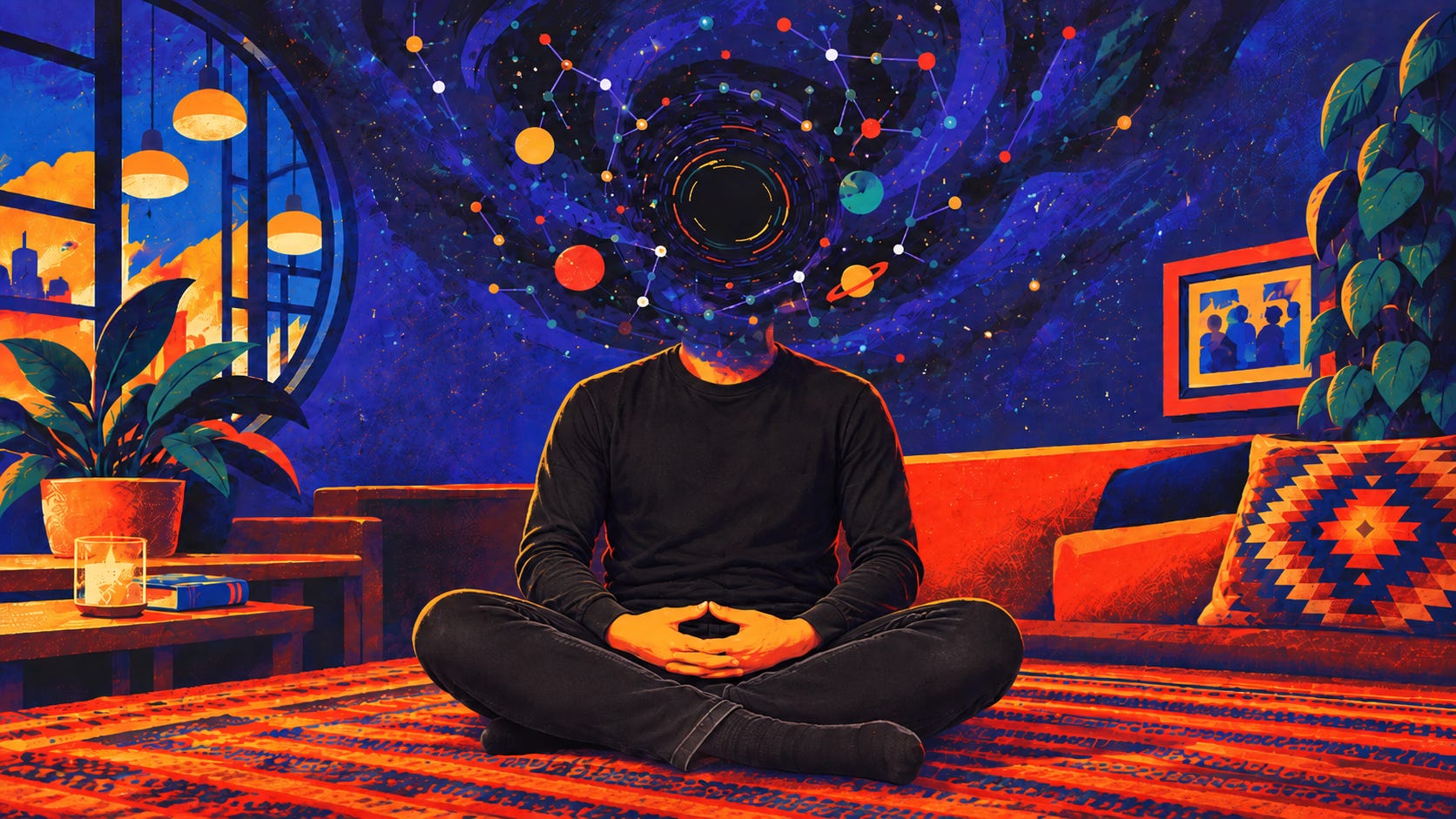
I’ve stopped reading Western philosophy. For the most part.
Over the past ten years, I’ve spent countless hours studying the important philosophical texts by the greatest thinkers. Plato. Aristotle. Bacon. Descartes. Kant. Schopenhauer. Nietzsche. Sartre.
I’ve even spent time with lesser-known downers. Michelstaedter. Mainländer. Zapffe. Benatar. Ligotti. Thinking, for whatever reason, that they might have something novel to say about the world.
I searched the works of these thinkers like the Bereans searched the scriptures.1 But in the end, I discovered a lot of selfishness, self-delusion, and self-righteousness smeared across the pages. And just as dogmatic as religion, in many cases.
But it wasn’t all bad.
I learned a lot over the past decade. And I don’t regret any of it. But at some point, I realized that it was time to move on.
My inevitable divorce from Western philosophy happened after reading a little book called On Having No Head. By an English writer named Douglas Harding. Sam Harris had mentioned the work during one of his podcast episodes. So, I gave it a read.
To make a short story shorter, On Having No Head changed my life. It ignited my first spiritual experience. Right there in a Biggby Coffee in East Lansing, Michigan. I realized I had no head.
Literally.
It took me no time at all to notice that this nothing, this hole where a head should have been was no ordinary vacancy, no mere nothing. On the contrary, it was very much occupied. It was a vast emptiness vastly filled, a nothing that found room for everything—room for grass, trees, shadowy distant hills, and far above them snow-peaks like a row of angular clouds riding the blue sky. I had lost a head and gained a world. -Douglas Harding
When I looked around the coffee shop, I could see everyone else’s head. But I couldn’t see my own. In place of my head was the world. Chairs. Tables. Coffee. Baristas. Doors. Windows.
I was, experientially speaking, the universe.
Everything played upon the surface of my eyeballs. There was no there there. There was only here. There was no past. There was no future. There was only right now. Right this second.
This struck me as so obvious. It had been right there the whole time.
Call it a flow state. Call it dissolution of the self. Call it Buddha nature. Call it whatever you want. All I know is that, for those few moments, I had experienced the universe for what it is. Everything was connected. There were no independent objects in the world.
It was one, cohesive whole.
What actually happened was something absurdly simple and unspectacular: I stopped thinking. [...] Reason and imagination and all mental chatter died down. For once, words really failed me. Past and future dropped away. I forgot who and what I was, my name, manhood, animalhood, all that could be called mine. It was as if I had been born that instant, brand new, mindless, innocent of all memories. There existed only the Now, that present moment and what was clearly given in it. To look was enough. And what I found was khaki trouserlegs terminating downwards in a pair of brown shoes, khaki sleeves terminating sideways in a pair of pink hands, and a khaki shirtfront terminating upwards in—absolutely nothing whatever! Certainly not in a head.
It took me no time at all to notice that this nothing, this hole where a head should have been was no ordinary vacancy, no mere nothing. On the contrary, it was very much occupied. It was a vast emptiness vastly filled, a nothing that found room for everything—room for grass, trees, shadowy distant hills, and far above them snowpeaks like a row of angular clouds riding the blue sky. I had lost a head and gained a world. -Douglas Harding
Nothing that I’d read in Western philosophy had come close to achieving a description as sublime as the one above. Only later did I find that this experience, this realization, is the cornerstone of non-dual meditation taught in Zen, Dzogchen, and even Advaita Vedanta.
More recently, I have committed myself to the study and practice of Zen Buddhism.
Let your ears hear without trying to hear. Let the mind think without trying to think and without trying to stop it. That is practice. -Shunryu Suzuki
While you are continuing this practice, week after week, year after year, your experience will become deeper and deeper, and your experience will cover everything you do in your everyday life. The most important thing is to forget all gaining ideas, all dualistic ideas. In other words, just practice zazen in a certain posture. Do not think about anything. Just remain on your cushion without expecting anything. Then eventually you will resume your own true nature. That is to say, your own true nature resumes itself. -Shunryu Suzuki
Over the next few weeks, I will do an in-depth study of On Having No Head. What makes this little book so compelling is that it invites you to experience what Harding experienced, as opposed to learning intellectual concepts.
There is a lot more to say. But I will leave it here for now.

This newsletter is about thinking clearly about culture, science, religion, and the inner life. I’m not here to persuade you. Only to share what I find interesting. Maybe this article did not resonate with you. But maybe the next one will.
If you would like to follow my journey, consider subscribing to this newsletter. Two articles are published every single week. Maybe you will learn something. Or maybe you will have something to teach me about the topic. Either way, I would love to hear from you.
Thank you for being here. It means the world to me!
Acts 17:11